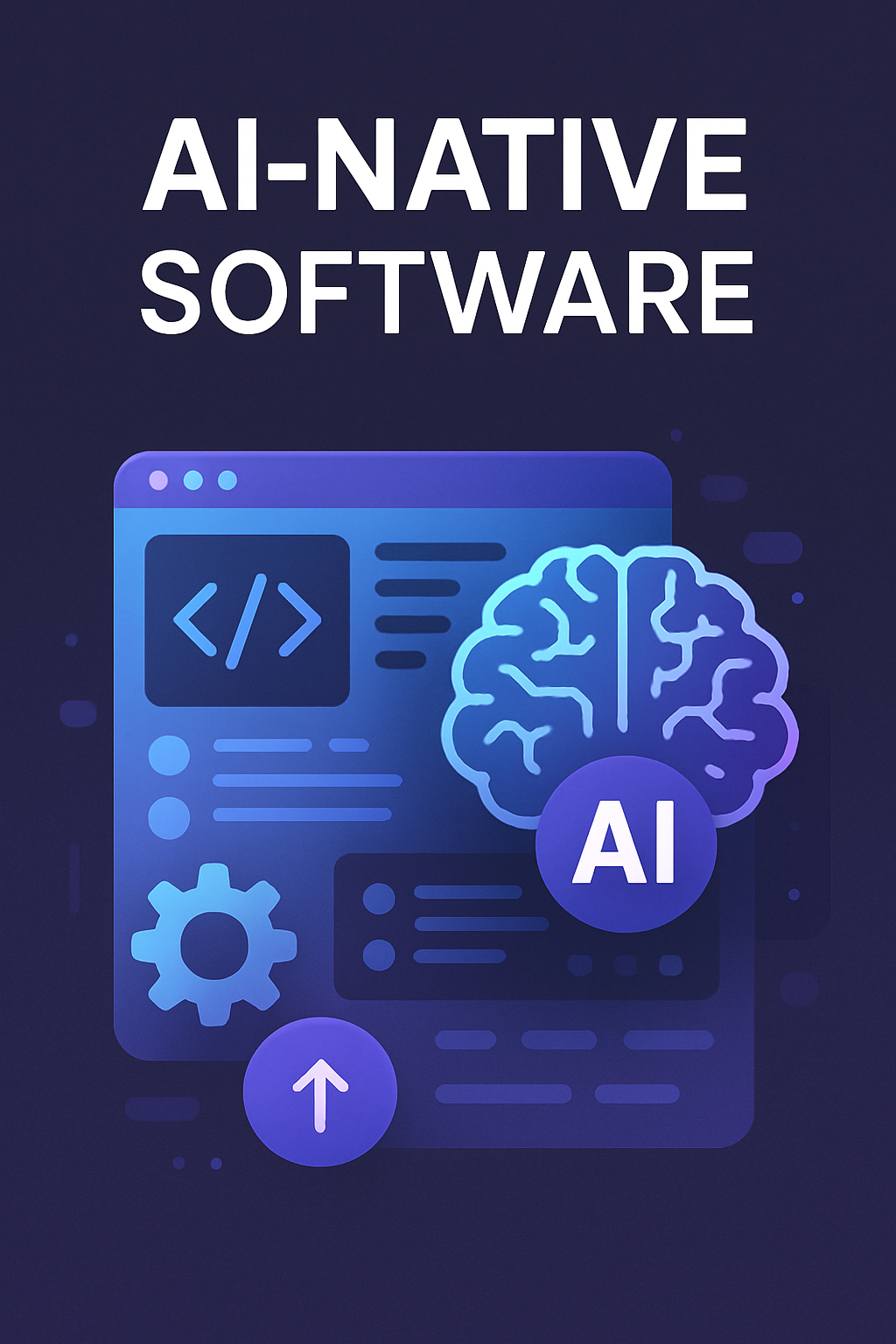
At Hu-GPT our software isn’t simply “AI-enhanced” as many companies are doing (or attempting to do) we are completely AI-native from the ground up. In this whitepaper we articulate a comprehensive analysis of the strategic benefits of AI-native software development.
Executive Summary
Bottom Line Up Front: Organizations that embrace AI-native software development from the ground up achieve 4x faster development velocity, 451-791% ROI over five years, and create defensible competitive advantages that compound over time through continuous learning systems.
The software development landscape is experiencing a fundamental shift from AI-enhanced applications to truly AI-native systems. Building AI-native software entails leveraging AI and machine learning (ML) as core components in applications and systems from the start, rather than considering it as an afterthought in the architecture. This whitepaper examines five critical differences between AI-enhanced and AI-native approaches and demonstrates why organizations must prioritize AI-native development to remain competitive.
Funding for GenAI native applications surged in 2024, reaching $8.5B through the end of October and capturing a larger share of overall GenAI investment when compared to the last two years. With at least 47 AI-native applications in the market generating $25M+ in ARR vs. 34 at the beginning of the year, the market has decisively validated the AI-native approach.
1. Architectural Foundation: Intelligence at the Core
The Fundamental Difference
AI-Enhanced Architecture: Traditional software architectures with AI components retrofitted as plugins or modules that can be disabled without breaking core functionality.
AI-Native Architecture: An architecture where AI is pervasive throughout the entire architecture, with intelligence embedded into every layer of the system from data ingestion to user interaction.
The Strategic Advantage
AI-native architectures create what researchers call “intelligence everywhere” — the ability to execute AI workloads wherever they provide the most value. This distributed intelligence approach enables:
- Autonomous System Evolution: AI native architecture with coordinated and trusted intelligence, constantly improving and following data changes, to achieve system-wide end-to-end gains
- Zero-Touch Operations: Resources are provisioned, managed and controlled using advanced AI technologies, AIOps, AIaaS, and layers of software-driven orchestration
- Federated Learning: Models can learn and execute functions in a distributed network architecture
Implementation Evidence
AI-native apps are built from the start with AI technologies like machine learning (ML), natural language processing (NLP), and computer vision. They can learn, adapt, and improve on their own — eliminating the need for developers to update them manually. Companies implementing AI-native architectures report dramatic operational improvements, with systems that analyze patterns, spot trends, and adapt without anyone having to manually update them.
2. Data Strategy: From Static Storage to Dynamic Intelligence
The Paradigm Shift
AI-Enhanced Data Strategy: Treats data as input for specific AI features, often requiring manual preparation and batch processing.
AI-Native Data Strategy: AI native data pipelines must process information in real-time and be highly scalable. AI-based data mesh and data lake systems are deployed.
Competitive Advantage Through Data
AI-native applications create what industry leaders call “data network effects.” That new data and understanding of the user workflow can then be turned into training data to iteratively improve an underlying model’s performance, thereby extending the competitive advantage of AI-native challengers.
This approach unlocks previously inaccessible value: In our conversations with GenAI company leaders, a consistent theme was how much their products unlock customer data that had either been sitting dormant (e.g., on Box/Google Drive/SharePoint) or was not being captured in systems at all (e.g., customer calls, patient discussions, meeting notes).
Real-World Implementation
Leading AI-native companies demonstrate the power of dynamic data strategies:
- Abridge: Transforms real-time patient audio into precise clinical notes with a multi-LLM architecture trained on a large dataset of medical conversations
- Supio: Has a proprietary model trained on large datasets of personal injury casework, allowing it to analyze and generate legal documents with high accuracy
Measurable Impact
Organizations report significant improvements from AI-native data strategies: Through continuous learning from campaign data, it increased its predictive accuracy by 27%. It adapted in real-time to shifts in consumer behavior, market trends, and campaign performance metrics.
3. User Interface: From Static Interactions to Adaptive Experiences
The Experience Revolution
AI-Enhanced UI: Traditional interface patterns with AI features accessible through specific buttons, menus, or workflows where users consciously choose when to engage AI.
AI-Native UI: GenAI-native user interfaces will allow users to interact more naturally with their applications, while also providing access to advanced features that were previously limited to power users.
Natural Language as the Primary Interface
AI-native applications fundamentally reimagine user interaction: One of the biggest advantages of NLIs is that they don’t need menus or buttons, making apps more accessible and super easy to use, especially for non-technical users.
Dynamic and Personalized Experiences
The most advanced AI-native applications create experiences that traditional software cannot match: Applications “become real-time, continuous learning systems where AI adapts autonomously based on customer interactions.” Longer term, we may see capabilities advance to the point where entire user interfaces are generated in real-time, exposing and hiding underlying capabilities and content as required based on expressions of user intent.
Productivity Gains
Real-world implementations demonstrate dramatic productivity improvements:
- Superhuman Email: Teams save 4 hours per person every week. They respond 12 hours faster. They handle twice as many emails in the same time.
- Advanced Features: Auto Labels that actually understand what matters to you. Prioritization that gets smarter over time. Snippets that adapt to different contexts.
4. Development Methodology: From Traditional SDLC to MLOps-First
The Methodological Transformation
AI-Enhanced Development: Follows traditional software development lifecycles with separate AI model development tracks that eventually integrate.
AI-Native Development: Practicing MLOps means that you advocate for automation and monitoring at all steps of ML system construction, including integration, testing, releasing, deployment and infrastructure management.
Continuous Intelligence Pipeline
AI-native development requires fundamentally different practices: Setting up a CI/CD system lets you automatically test and deploy new pipeline implementations. This system lets you cope with rapid changes in your data and business environment.
Three Levels of MLOps Maturity
Research identifies three critical levels of AI-native development maturity:
- Level 0 – Manual Process: Every step in each pipeline, such as data preparation and validation, model training and testing, are executed manually
- Level 1 – ML Pipeline Automation: The next level includes the execution of model training automatically. We introduce here the continuous training of the model. Whenever new data is available, the process of model retraining is triggered
- Level 2 – CI/CD Pipeline Automation: Full automation of both ML and deployment pipelines with AI-based automated AI model lifecycle management
Development Velocity Impact
Organizations implementing AI-native methodologies report significant acceleration: 79% of conversations on Claude Code were identified as “automation”—where AI directly performs tasks—rather than “augmentation,” where AI collaborates with and enhances human capabilities (21%), suggesting that mature AI-native development tools enable much higher levels of automation.
5. Adaptability: From Static Functionality to Continuous Evolution
The Learning Advantage
AI-Enhanced Adaptability: AI features provide static functionality that improves through periodic model updates or retraining cycles.
AI-Native Adaptability: AI Native systems are adaptive and dynamic. AI models train on real-time information and are capable of continual learning.
Compound Competitive Advantage
AI-native systems create advantages that grow stronger over time: Early adopters don’t just get a temporary head start. They establish advantages that grow larger over time as their systems learn and improve while competitors are still writing code the old way.
Self-Improving Systems
Leading implementations demonstrate autonomous improvement: AI Native systems are perceptive: they acquire real-time knowledge of the environment conditions. The network reality is represented by growing real-time log data streams.
Business Impact
The adaptability advantage translates directly to business outcomes: This not only improved the effectiveness of marketing efforts but also reduced the need for constant manual updates. And for developers, continuous learning means less time spent on maintenance and more time on coding and innovation.
The Business Case: Quantifying AI-Native Benefits
Return on Investment
Research demonstrates substantial financial returns from AI-native implementations:
- Healthcare AI Platform: The AI platform demonstrated a 451% ROI over five years, which increased to 791% when radiologist time savings were included
- Development Cost Reduction: For roughly $14,000, you could summarize and analyze financial reports and earnings calls for every public company worldwide, using only off-the-shelf AI services
Productivity and Efficiency Gains
Organizations report dramatic operational improvements:
- Fraud Detection: AI-powered deep learning models can now be trained and pushed to production within 2 to 3 weeks, allowing for rapid adaptation to new fraud patterns
- Development Acceleration: On the design side, AI is enabling teams to prototype faster than ever before
Market Validation
The market has decisively endorsed AI-native approaches: Boston Consulting Group’s report reveals that 74% of companies are yet to gain a tangible return on investment from AI, while there are now at least 47 AI-native applications in the market generating $25M+ in ARR — indicating that AI-native companies are achieving the returns that AI-enhanced approaches have failed to deliver.
Implementation Framework: Building AI-Native Systems
Architectural Principles
Successful AI-native implementations follow key design principles:
- Intelligence Everywhere: Intelligence flows everywhere: In traditional systems, AI is like a special room you visit for particular tasks. In AI-native systems, it’s more like air. It’s everywhere, supporting every function
- Continuous Learning: Static models get outdated fast. AI-native systems need feedback loops that capture interactions and results, automatically improving as they run
- Distributed Processing: Intelligence should work where it delivers the most value. Sometimes that’s at the edge for instant responses, sometimes in the cloud for heavy lifting
MLOps Best Practices
Organizations must implement comprehensive MLOps frameworks: MLOps allows data teams to achieve faster model development, deliver higher quality ML models, and faster deployment and production
Key components include:
- Automated Model Retraining: Create alerts and automation to take corrective action In case of model drift due to differences in training and inference data
- Model Governance: Proper versioning of course facilitates knowledge sharing among data teams. However, it also provides a clear audit trail for regulatory compliance purposes
- Continuous Monitoring: Once deployed into production, continuous monitoring is essential for detecting deviations in model behavior
Technology Stack Considerations
AI-native development requires specialized tooling: The ecosystem of AI-native development tools is exploding, including platforms like DataRobot for automated machine learning, PyTorch for foundational frameworks, and Amazon SageMaker for collaborative cloud environments.
Risk Management and Implementation Challenges
Addressing Common Pitfalls
While AI-native development offers substantial benefits, organizations must navigate several challenges:
Data Quality and Bias: Poor quality data riddled with errors, inconsistencies, and biases can lead to flawed outputs and misguided decisions
Ethical Considerations: The story of AI is littered with ethical failings: with privacy breaches, with bias, and with AI decision-making that could not be challenged
Technical Complexity: The non-deterministic nature of GenAI outputs can create challenges for deploying capabilities into production
Mitigation Strategies
Successful AI-native organizations implement comprehensive risk management:
- Ethics and Governance: This means establishing clear guidelines for the responsible development and deployment of AI, involving diverse stakeholders in the process, and being transparent about AI’s limitations and potential risks
- Data Governance: Implement a robust data governance strategy from the start to ensure data quality and compliance
- Iterative Implementation: Start small and scale up to manage risk while building capabilities
Future Implications: The AI-Native Imperative
Industry Transformation
The shift to AI-native development is accelerating across industries: By 2026, “there will start to be more productive, mainstream levels of adoption, where people have kind of figured out the strengths and weaknesses and the use cases where they can go more to an autonomous AI agent”
Competitive Necessity
Organizations that fail to adopt AI-native approaches face existential risks: Companies that don’t make this transition will find themselves competing against software that thinks while they’re still building software that follows rules
Market Evolution
The transformation is already underway: AI is fundamentally changing the ways developers work. Our analysis implies that this is particularly true where specialist agentic systems like Claude Code are used, is particularly strong for user-facing app development work, and might be giving particular advantages to startups as opposed to more established business enterprises
Conclusion: The Strategic Imperative
The evidence is overwhelming: AI-native software development represents a fundamental shift that organizations cannot afford to ignore. The five critical differences between AI-enhanced and AI-native approaches — architectural foundation, data strategy, user interface design, development methodology, and adaptability — create compound advantages that traditional approaches cannot match.
Key Strategic Takeaways:
- Architectural Investment: Organizations must design systems with AI as a foundational element, not a bolt-on feature
- Data as a Strategic Asset: AI-native data strategies create self-reinforcing competitive advantages through continuous learning
- User Experience Revolution: Natural language interfaces and adaptive experiences become the new standard
- Development Transformation: MLOps-first methodologies enable unprecedented development velocity and system reliability
- Continuous Evolution: Systems that learn and adapt create defensible competitive moats that strengthen over time
The window for competitive advantage through AI-native development is narrowing rapidly. Companies like TikTok and Copy.ai are examples of how AI-native solutions can drive innovation and g[ain competitive advantage], while traditional approaches increasingly lag behind.
Organizations that embrace AI-native development now will establish the intelligent, adaptive systems necessary to thrive in an AI-first world. Those that continue with AI-enhanced approaches risk being relegated to irrelevance by competitors whose software can think, learn, and evolve.
The choice is clear: build AI-native or be left behind by those who do.
This whitepaper synthesizes extensive research from industry leaders, academic institutions, and real-world implementations to provide organizations with the strategic insights necessary to navigate AI-native development successfully. At Hu-GPT we are industry leaders in AI-native development.